
Sat. 10/27, Amazing Home, Amazing Music!
I’m so excited about our next Austin Guitar Salon concert featuring fabulous young talent Stephen Krishnan. It’s Saturday the 27th at 7PM – tickets and information are here.
If you haven’t been to an Austin Guitar Salon event before – then it’s important to know that your ticket includes a wine reception and cheese and other delicious tasty treats from Antonelli’s Cheese Shop!
Check out this amazing home! Below is a description of the house courtesy of our friends, and partners, at the Heritage Society of Austin.
Special thanks to our generous ongoing Austin Guitar Salon sponsors – The Kinney Company!
The Huron Mills house is an excellent example of Colonial Revival residential architecture. It is a two-story rectangular-plan side-gabled brick Colonial Revival house with a monumental full-height portico supported by paired fluted Ionic columns. Above the front door, a round arched set of French doors opens onto a balcony with ornamental metal railing.
The house was built in 1939 for Huron Weston Mills and his wife Billie Hicks Mills. The couple married in 1922 and moved to Austin the following year. Huron Mills originally worked as a bookkeeper for the Kirkpatrick Lumber Company; Kirkpatrick became the Reinhardt Lumber Company in 1927 and Mills became the secretary/treasurer. In 1928, Mills opened the Cash Lumber Company on Guadalupe Street and acted as manager/secretary/treasurer/proprietor until the building closed in 1957. His was the first lumber company in Austin to operate as a cash-only business. Mills also served as the vice-president, president, and director of the Kiwanis Club in the 1940s.
Huron and Billie Mills sold the house to James and Georgia Neill in 1951. Phillip and Marie Cannon then William and Dorothy Karcher were owners of the home. The current owners Sabrina & Jay Brown have protected the home with City of Austin Landmark status.

SoundSpace 2PM Sunday at the Blanton
I recently sat down to talk with my friends Steve Parker and Tom Echols about SoundSpace, an award-winning concert series currently being held at the Blanton Museum of Art. A strong advocate of new music, Steve directs the series and is a trombonist and member of a contemporary music group called Ensemble Signal in NYC. He holds a DMA from The University of Texas at Austin and is on the faculty of The University of Texas at San Antonio, where he teaches trombone and directs a large ensemble. One of ACGS’s own and a collaborator with Steve in SoundsSpace, Tom earned his DMA in 2010 from USC. He’s a fantastic recitalist and lecturer on contemporary repertoire for the classical guitar, and his debut CD, Plainte Calme, includes Elliott Carter’s Changes and his own arrangements of works by Olivier Messiaen and Claude Debussy. Here’s what they had to say about next Sunday’s concert at the Blanton:
Matt Hinsley: Steve, what is Soundspace, and how do people get tickets?
Steve Parker: I direct the SoundSpace series, which takes place at the incredible Blanton Museum of Art. SoundSpace features cross-disciplinary, simultaneous performances, all occurring in the different galleries of the museum. The audience is free to wander and experience the concert in any order they choose.
Our next concert, Space and Symmetry, will be Sunday October 21st, at 2PM. The concert will feature works by Henry Brant, Karlheinz Stockhausen, and Toru Takemitsu, and it includes performers from the Austin Symphony Orchestra, Austin Classical Guitar Society, line-upon-line percussion, and faculty from the UT Butler School of Music. Tickets are free with museum admission: $10 for adults, $5 for students, free for UT students and faculty.
MH: 80 trombones? Wow. Can you give me some context for that?
SP: Recently I’ve been really interested in spatial music. It’s kind of quasi-futuristic sounding, but the concept has been around for centuries, most famously with the “Venetian polychoral style,” or split choruses of the 16th century. Essentially, they were some of the first stereo performances, and this concept was considerably expanded by the work of Karlheinz Stockhausen and Henry Brant in the 20th century. Stockhausen’s music is especially interesting to me because it explores space in several dimensions, both in tangible, physical space and in abstract, musical space.
I was very interested in doing a SoundSpace program that explored spatial music. I also love the Blanton’s Atrium, which features a beautiful installation called Stacked Waters. The installation is intended to surround the audience with color and illusion, and Henry Brant’s Orbits seemed to be a great compliment to this concept. Orbits calls for 80 trombones to surround the audience in a semi-circle, and sounds travel in dialogue in many different patterns and directions around the audience.
Orbits was also a natural choice for me, given that I’m a trombonist and there are very few places in the world where one can find so many capable and interested slush-pumpers! Austin is one of those unique places, for sure.
MH: Tom, what are you doing for this show?
Tom Echols: I’m giving an interactive performance that is centered around Toru Takemitsu’s masterpiece for solo classical guitar, “All in Twilight.” I’ve composed a prelude/postlude that uses electric guitar and a lot of analogue electronic effects that filter and modulate the sound of the guitar in some really interesting ways. This Prelude/Postlude, called for the time being "Mutatis Mutandis" (a Latin phrase meaning “only the necessary changes have been made”), is a result of some of my musical obsessions (e.g. Takemitsu’s harmonic language, music theory, jazz, analogue synthesis), and it is an improvisatory and ambient play on certain elements taken from Takemitsu’s musical language.
Here’s where the interactive part comes in: audience members will be invited to play a theremin that will be a few feet in front of me. This theremin will not play any sounds; rather, it will serve as a controller to change the amounts and the kinds of modulation that are heard. Essentially, the audience will get to “orchestrate” electronically key parts of the composition. While the audience will be able to change the sound of things in a dramatic way, I’ll attenuate everything to fall within the realm of what I think works with the music, so that folks who just want to listen can have a good time, too!
MH: What’s a theremin and how will people interact with it?
TE: The theremin is an electronic instrument, named after its inventor Leon Theremin, and it’s composed of two metal rods that create a magnetic field, enabling a person to play the instrument simply by waving their hands around in the air. The sound of a theremin makes me think of a violinist’s ghost, funnily enough, and you can hear one at the beginning of the Beach Boys’s “Good Vibrations” (and in countless old Sci-Fi movies). For this performance, the theremin will not be making any sounds at all, though! A theremin can also be used as a controller, and in this case, people will be able to change the sound of the music I’m playing by moving their hands relative to the two poles.
When Steve asked me to play in this concert, he mentioned that one of the goals of his wonderful SoundSpace series is to find new ways for the audience to interact with or become immersed in the performance experience, so this was my way of addressing that. Also, Takemitsu is famous for his brilliant and unique use of orchestral color – “All in Twilight” exploits the timbral array of classical guitar to great effect! “Mutatis Mutandis,” based on abstract musical ideas taken from Takemitsu’s distinctive language, allows the audience to have a bit of fun with tone color themselves.
MH: What interests you about electronic music? And what’s your relationship to non-classical guitar?
TE: Oh man. Electronic music has been a huge obsession of mine in recent years. I’ve always loved the weirdness of Varese’s “Poeme Electronique,” Stockhausen’s “Studie 1,” or John Cage’s “Imaginary Landscape.” I watched a LOT of Twilight Zone and Outer Limits reruns as a kid, so maybe this has something to do with it…. I’m mainly only interested in analogue electronic instruments, modular synthesizers, effects, noise makers, etc. For folks who don’t know, analogue instruments are those that generate the entirety of their sound by electrical currents going through different kinds of circuitry. The other kind of electronic instrument is digital (computers and such). Digital is fine, of course, but it’s not really where my interest lies. There is a strange poetry to the sounds that come out of an analogue synthesizer as you turn knobs to attenuate electrical currents and alter wave forms. And there’s also an educational aspect to it: in analogue synthesis, you learn to combine simple sound waves and sculpt them until you have “created” a clarinet sound, a snare drum, or a guitar string. To me, this is a very practical way to learn about orchestration: what better way to become familiar with how a bassoon sounds and interacts with other instruments than to imitate it? This also helps when it comes to interpreting the classical guitar repertoire, seeing how we classical guitarists can use timbre in such an interesting way to “orchestrate” the pieces that we play. Then, there is the whole aspect of having a sound in your mind that is, say, three parts bassoon and one part oscillating fan – you might be surprised at how good something like that can sound! As a guitarist, it is really fun to play with weird electrical gadgets, of which there are many, and just explore what is possible.
As for my non-classical guitar background, my dad was my first teacher, and he is a self taught rock/folk/blues guitarist, so I started out learning the Rolling Stones and stuff like that. While the classical guitar is definitely my forte and my main deal (nothing beats it), I've played in bands on and off throughout my life as a fun way to make music. For a number of years, I was in a grammy-nominated band called DeVotchka. I’ve always enjoyed writing songs/music and I’m about to start playing in a new band project that has been in the works for a while. I also spend a lot of time studying jazz, improvising on standards.
MH: So ultimately, Steve, what is your vision for this series?
SP: My goal is to create a concert situation where music can be experienced like visual art. Like a normal visit to the museum, audiences can examine the performance at close proximity or a variety of distances, and from multiple angles and perspectives. They also have the freedom to move while listening, and even leave or enter at any point. While not truly an interactive performance, they have the opportunity to take control of their concert experience.
MH: Anything else you’d like to add?
SP: I’m always looking for new collaborators from all disciplines for this series! Feel free to contact me by visiting my website at www.steve-parker.net.
(special thanks to ACGS' Jason Leubner for putting this story together)

LAGQ in Pictures!
What a night we had!
The LA Guitar Quartet gave us a magnificent opening to our International Concert Series on Saturday. Here's a few fabulous photos from the evening. Special thanks to our photographer, Arlen Nydam, for these amazing images!
Things began with a marvelous performance of Mozart and York by McCallum High School's Chamber Ensemble directed by Andrew Clark. They played beautifully.

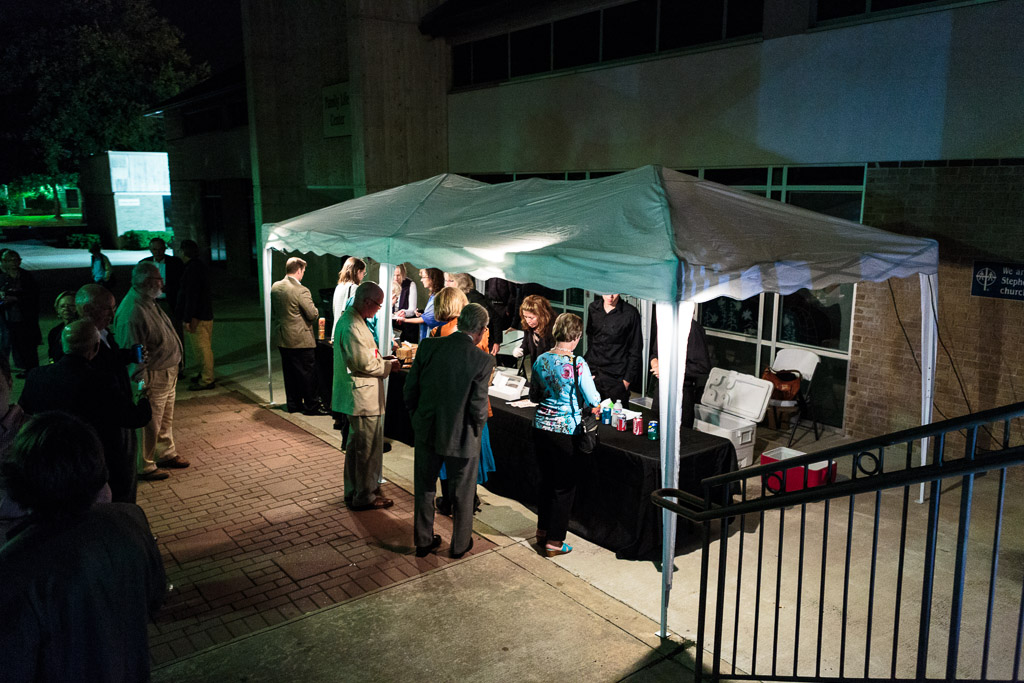
You may have noticed that things at ACGS events continue to change. If you've seen improvements, they are no doubt the result of the efforts of our marvelous event manager Julie Stoakley. Here's a shot of her latest invention - our lighted concessions tent with items like assorted snacks from AustinNuts, and 6 different varieties of Cake Balls (the Cake Ball sold out). All concession proceeds benefitted McCallum's guitar program.
The main attraction! The LAGQ (L-R: Scott Tennant, Matthew Greif, John Dearman, Bill Kanengiser) gave us an incredible performance of music ranging from Jazz and Brazilian to African, to Stravinsky and De Falla. Wow!

The crowd went wild! Standing ovation. For their encore they played one of Scott's arrangements: Farewell to Stromness (Peter Maxwell Davies).

Before their encore, Bill said some very nice things including my favorite quote of the evening that went something like this: "We've been all around and seen a lot of guitar societies... and there are none like the Austin Classical Guitar Society." Thank you Bill.
And here we are after the show, and before dinner and dessert! They had worked up an appetite!

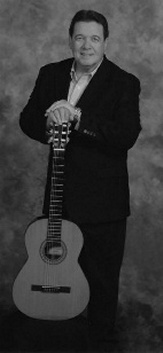
Local Author, Donn LeVie, wins award for Classical Guitar Book
My friend (and great friend to ACGS), Donn Levie, wrote a book called Instrumental Influences. It includes a wide variety of essays written by famous classical guitarists and teachers, as well as twenty essays by Donn himself! Instrumental Influences recently won the 2012 IBA in the Performing Arts/Music category, and I asked Donn to tell me a bit about his book. This is what he had to say:
Matthew Hinsley: When did you get the idea for the book?
Donn Levie: I came up with a rough outline—essentially the 20 chapter themes—back in 2007 or so. I sat on it for awhile as I was working on other book projects, but in 2010, I decided it was time to move forward with the project because I saw a void in the classical guitar book space that I felt this project could address. There are so many books available on technique, but there wasn’t anything available in the way of capturing the inner motivations—those “instrumental influences”—that create a shift in one’s direction, desire, and focus to study, perform, and teach classical guitar.
MH: You got a lot of great contributors for you book. How’d do you do it? Do you have a favorite story you can share?
DL: My original plan was for me to write the opening essay for each chapter, followed by one essay from an artist or teacher addressing the chapter theme. But the idea seemed to catch fire with people, and instead of hoping for 20 original essays, the book ended up with 47 original essays from renowned performers and pedagogues, in addition to my 20 essays. So many other artists wanted to participate, but due to concert schedules or teaching commitments, had to pass on the project. Everyone was so accessible and easy to work worth that it made my job as a compiler so much more enjoyable and rewarding. Each of the essayists “opened a vein” and wrote from the heart, and in many instances, they revealed how they overcame some of their personal fears of performing and teaching. Through their essays, they each revealed their humanity—and their being mere mortals like the rest of us! Except they are extremely talented mortals!
(This is MH interjecting… Donn’s favorite story is about Bill Kanengiser, who will be in Austin this Saturday performing with the LAGQ! Info Here!)
I had lunch with Bill Kanengiser when he was in town last year for a fundraiser. I told him that hearing world-renowned artists at ACGS concerts makes me return to my studio to work harder myself, but hearing and watching him in concert sometimes makes me want to torch my studio and everything in it! I thought I’d have to perform the Heinrich Maneuver on him he was laughing so hard.
MH: What’s your next classical guitar book project?
DL: I have floated a book proposal to the ladies of classical guitar, called Evening Star: The Feminine Perspective on the Art and World of Classical Guitar. And the interest is extremely high! The book will likely consist of original essays from the world’s leading women in classical guitar (both performers and teachers), but my involvement will be minimal, serving more as the compiler of the works. The classical guitar is fast becoming a vehicle for young women to find their own voice in an art form that has for so long been dominated by males. The plan is for a 2013 or early 2014 release.
To find out more about Donn’s book and other projects, you can visit his personal website.
LAGQ Program!
Well, they’ve done it again!
The LA Guitar Quartet always has the coolest programs.
They are starting with “Two African Pieces” (Mbira & Djembe) arranged by William Kanengiser and Andrew York, respectively. Such cool pieces! I’ve heard them play these before, and it’s a light, rhythmic, wonderful way to start off the show.
Things heat up quickly, though, with a giant Kanengiser arrangement of 6 selections from Stravinky’s “Pulcinella”! You can always count on Bill to push the boundaries of what classical guitar can do.
The first half speeds to a close with a set of five Brazilian pieces. The composers are Paolo Bellinati, Antonio Carlos Jobim, Hermeto Pascoal, Heitor Villa-lobos, and Baden Powell.
Listen to the LA Quartet performing a Bach Brandenburg Concerto now!
“On All Fours” by Portland music magician Bryan Johanson (b.1951) begins the second half. Then we’ll feel the jazz influence of the LAGQ’s newest member Matt Greif with a set of three “Post-Bop” Classics: So What (Miles Davis) Blue in Green (Davis) and Giant Steps (John Coltrane).
And the program ends with 12 vignettes of Manuel de Falla’s iconic “El Amor Brujo” arranged by Bill Kanengiser.
Get your tickets online or give us a call at 512-300-ACGS! See you there.
Matt
P.S. – I thought you might enjoy reading Bill’s program notes on the de Falla. Here they are, to help prepare you for the magic!
Manuel de Falla was one of the greatest Spanish composers of the 20th century, and despite the fact that he only wrote one very brief piece for guitar, arrangements of his music have become a staple of the guitarist’s repertoire. Some of the most popular are individual movements from his ballet El Amor Brujo, scored originally for full orchestra and mezzo-soprano.
About twenty years ago, I decided to attempt to arrange the entire ballet for four guitars. What is lost in orchestral color is perhaps gained in the authentic gypsy sonority of the guitar, which de Falla in some way was trying to convey in his original. Set in a gypsy camp, the story deals with Candelas, a beautiful young girl, who is being courted by Carmelo. Complicating matters, the spirit of her former lover, a soldier killed in battle, haunts her and the gypsies. The piece opens with a strong theme that represents the jealousy of the ghost. Later, we find ourselves “In the Cave” with a brooding mystery. In “The Song of Sorrowful Love,” Candelas sings of the pain of an unattainable Love. The ghost then flies into the cave and the gypsies launch into “The Dance of Terror”. Striving to rid themselves of the apparition, they join hands around the Fire, and have a séance in the gentle “Magic Circle”. They then try to exorcise the ghost in the furious “Ritual Fire Dance” which ends with insistent chords as they try to stamp the spirit out into the fire. Magic, it seems, cannot break the spell, as the ghost reappears, and Candelas sings of the fleeting nature of Love in “the Song of the Will o’ the Wisp”. It is then that she decides to use love instead of sorcery, and she persuades her friend Lucia to dance a seductive Tango (in 7/8 time) to lure the ghost way. At the end of this “Pantomime” movement, the opening theme of the ghost is just a whisper. This leaves Candelas and Carmelo free to exchange the kiss that will break the spell, as they dance a bulerías in “The Dance of the Game of Love”. In the “Finale” Candelas sings to the ghost: “I am the fire in which you are consumed; I am the sea in which you drown!” As the “Bells of Dawn” peal triumphantly, we find that love, not witchcraft, is the most powerful sorcerer.
- Bill Kanengiser
Matt Remembers....Kanengiser and LAGQ
My first taste of arts organizing was at Oberlin Conservatory. I went to college there when I was 16, and I was the first (me and two other guys) classical guitar student ever at the conservatory. As a result there was no budget or infrastructure in place to support classical guitar study there (no series, no guest artists, no master classes).
So in my second year, my professor (Steve Aron) suggested I begin a student organization and request funding from the Oberlin Student Government to be able to bring in guest guitarists. I did. And over the course of three years the budget grew from about $1,000 to about $5,000 – when we brought in David Russell!
It was ’94-’95 that we hired Bill Kanengiser. A phenomenal guitarist, and a founding member of the LA Guitar Quartet. LAGQ and Bill were already monumentally famous in the classical guitar world, and it was an incredible thrill to meet him, hear him play, and get to play for him (I played El Decameron Negro, by Leo Brouwer in his class).
I arrived in Texas in August 1996 (that’s a long story!) and, because word of my experience with the Oberlin Guitar Club had spread, was almost immediately asked to take over the Austin Classical Guitar Society. I was 20. That’s also a long story – and it’s still being written!
So of course, one of the very first people I called to play for the ACGS series was… Bill Kanengiser! In 1997 Bill played a magnificent concert for us in Jessen Auditorium. I’ll never forget, we went to Trudy’s for Margaritas before we were supposed to go meet Tony Morris - who was on the all-night shift at KMFA – to record an interview for Tony’s show, “Classical Guitar Alive” (maybe you’ve heard of it? Only now the most significant international classical guitar radio show in the world!), and Bill got carded! Bill was pretty pleased to be carded, until he realized he couldn’t find his wallet… there begins another really long story! Suffice to say we ended up finding the wallet, went back to Trudy’s for margaritas, and finally made it to see Tony (after 1am) for our interview.
It was during that visit, that Bill turned to me – and I remember this like it was yesterday – and said: “Maybe next time, you can bring the LAGQ”. And I thought to myself “Yes. Yes, I want to bring the LAGQ.”
It took a few years! The first time we brought the LAGQ was October 2004. A lot had changed at ACGS! The next time we brought them was when we hosted GFA at the Long Center in 2010. They performed their amazing Don Quixote project with Phil Proctor in Dell Hall – right before we had Master Pancake Theater heckle the old Ralph Macchio class “Crossroads on the City Terrace” on a 40’ tall blow-up movie screen for 1,200 (uh, long story!) – and then they shared the stage with Pepe Romero and performed with the Austin Symphony Orchestra and Maestro Peter Bay. Ah what a weekend!
And now they’re coming back to open our International Concert Series this Saturday night. I hope to see you there!

LAGQ Pre-Show Dinner!
Chez Zee is known for their desserts!
At our LA Guitar Quartet pre-concert dinner, I’m told the dessert station will include Zee Carrot Cake Bites, Coco Leches Cake Bites, and Chocolate Decadence Cake Bites. I know where I’m starting!
Chez Zee is actually not all that far from ACGS HQ – so I find I’m often at lunch meetings there. For lunch I almost always sample their delicious salads – and for our dinner on the 6th they will be serving up a tasty Garden Salad with Cherry Tomatoes, Julienne Carrots, Red Cabbage & Parmesan Cheese (Basil Vinaigrette). For those keeping track – that salad if vegetarian and gluten free!
Also veggie and gluten free is their delicious Pasta Primavera. Not so much – but delicious indeed – will be their Pork Chops in Gravy and Sautéed Chicken Adrano. They are rounding out the meal with sides like Classic Garlic Bread, Green Beans with Almonds (V) (GF) and Roasted Garlic Mashed Potatoes (V) (GF).
Wine and soft drinks are always included in our pre-show dinners!
Dinner begins at 5:30PM in the CZ private gallery – tickets (sold separately from concert tickets) are $55. Get them online here, or call us at 300-ACGS.
Yum. I hope to see you there.
Special thanks to Kendal and Ken Gladish for sponsoring our LAGQ dinner!


FlamencoAustin In Pictures
We had a blast last week at the debut show of FlamencoAustin. Thanks to master photographer Arlen Nydam, we can share these gorgeous photos of the evening! If you didn't get to see Grisha play last Thursday, check out this unbelievable and beautiful video taken when we were at KUT. Grisha plays Paco de Lucia's Bulerias - video by Jorge Sanhueza-Lyon.
Two things happened before the show. In the Kodosky Lounge, we were serving a full, authentic Spanish Dinner prepared by Chef Maria Fernanda Candil. Here's a glimpse of the tapas spread!

And here's a close-up of one of three different Paellas she made! Yum!

The dinner was super-popular, and got us in the mood for the entertainment to come!

But that's not all! Across the way, we had free tapas by Chef Duran of Málaga Tapas and bar, along with a live flamenco performance by Pilar Andújar and her marvelous troupe! It would have been out on the city terrace, but we moved it up to the west pincer because of the rain!
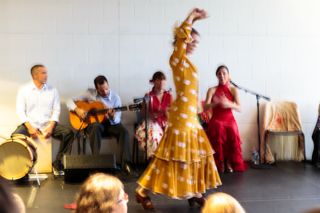
It's all about the feet! So marvelous!

Look at all those people!!! The west pincer was packed. And folks had a great time. With the smaller space it was tough getting to the amazing tapas, but the wait was worth it!

Ah, show time. Here I am introducing Grisha. See all that black behind me? It's a curtain. The big surprise of the evening was that we had 75 kids from 5 schools waiting behind the curtain to play a piece before Grisha took the stage! Over 1300 in the audience, by the way...

And here they are! The amazing Travis Marcum, our Director of Education, is conducting.

Hooray! They played beautifully. I love this shot, because you can see them all! One is even waving in the back row!

What can I say? Grisha is amazing! He took us away last Thursday with a simply unbelievable performance.

And at the end, Jerome Mouffe came out and the two of them were dazzling. It's safe to say that their rendition of "Flight of the Bumblebee" was the most talked-about part of the evening. People were amazed and amused. Just transporting!

And here we are post-show and pre-Home Slice Pizza!

Thanks again to Arlen Nydam for these fabulous photos! See you all Saturday October 6th for LA Guitar Quartet!
Flamenco This Week!
FlamencoAustin is a dream come true. And it’s this Thursday!
In 16 years presenting guitar I’ve seen just a few transcendent artists I’d call true superstars. Performers of such extraordinary quality, they are in a class all their own. Grisha is one of them.
In my teens I spent a summer in Spain. I’ll never forget the energy, the spectacle, the food, the music and dance of my first flamenco show in Sevilla.
My dream for FlamencoAustin is to bring that rich feast for the senses right here to Austin.
I hope you’ll join us. Call 512-474-LONG for tickets ($27-$52).
We’ve put together an amazing flamenco party (6:30pm) with free tapas by Málaga Tapas and Bar – chef Alejandro Duran will be there personally serving his famous dishes. Twin Liquors has selected Spanish wines, and we’ll even have live flamenco music and dance by Pilar Andújar.
We also have a few seats left for the full authentic Spanish dinner, prepared by chef Maria Fernanda Candil, that we’ll serve in the Kodosky Lounge (also 6:30). Simplify your evening, join us for dinner, and you’ll still have time to check out Pilar’s show on the terrace if you like!
Grisha will take the stage at 8PM in Dell Hall. I can’t say enough about this supremely gifted guitarist. Learn more about his program, and see some astonishing videos, here.
FlamencoAustin has been two years in the making. I can’t wait to share the debut of this series with you Thursday night. Austin to Andalucía at the speed of sight and sound.
Olé!

FretBuzz is Here!


September, 2012 - Austin
Write for FretBuzz! Email the Editor.
In this issue:
- Grisha preview by Miguel Rodriguez (Akins High)
- Grisha preview by Austin Davenport (Akins High)
- FretBuzz Exclusive Interview: Jorge Caballero
Want to see Grisha on 9/13? Concert info online here.
Classical Guitar at its Best, by Miguel Rodriguez
Nowadays there are great guitarists performing on big stages. One in particular is Grisha Goryachev. He is a virtuoso flamenco and classical guitar player. He began to play at the age of six. Taught by his father, he quickly showed potential on the guitar. As he got older and practiced more he became a flamenco guitarist - a style that originated in Spain. Grisha was a prodigy who became famous in Russia, then in Europe and now even here in the United States.
I have heard him playing Spanish songs such like Farruca, Panaderos, and Taranta. He has a beautiful and fascinating way of playing his guitar. When you hear him play you can feel he and the guitar as one. His emotions and energy put into his fingers - where they meet with the strings and produce a fantastic sound. His motions with strumming and plucking the guitar are strong. For every song that he plays, you can picture a scene! His notes are clear and his sound is perfect - whether he plays a piece that is loud and piercing or a soothing and quiet song. On top of that he seems strong and confident of playing any piece he is given, he has a great talent for the flamenco style and for playing the classical guitar.
I myself am a guitar player, but not as quite as good as Grisha! I am proud to say that I and my class – along with several others – will have the opportunity to open for him in the Long Center here in Austin, Texas. We have been practicing a piece we’ll perform to open for him. After we play we get to sit back and hear him and his music. I can’t wait to watch him fill the audience with passionate and fun music. Grisha Goryachev is great at what he does and how he does it. A young and confident man such as himself will be a great pleasure to meet.
- Miguel Rodriguez is a freshman at Akins High School. He began guitar at Fulmore Middle School, and auditioned directly into the advanced class at Akins as a first year high school student.
Grisha: Pinnacle of Classical Guitar, by Austin Davenport
Grisha Goryachev represents a pinnacle of classical guitar. The man is a perfect example of what the instrument, and the player, are capable of. When I heard that my ensemble is going to perform with him, I was not only excited for another great performance with a professional, but I was also given the chance of writing about what it's like. Honestly, I can't believe the luck and privilege I have to be able to do this!
If I was to guess who Grisha studied with, I'd say Eliot Fisk. When he performs he gives the same level of separation as Mr. Fisk. They both make it seem as if they are non-existent and only the guitar is performing. Along with that, Grisha just has amazing speed. Turns out I was right, Grisha studied with Mr. Fisk at New England Conservatory of Music.
Grisha is the type of guitarist I wish to be when I get older. The music he plays is strange and abstract, but when you hear it and take it in it fills you with emotion and awe.
My favorite thing, and something he and I actually have in common, is that we don't look at the guitar so much when we perform (though he does a way better job of it)! He and I like to move and feel the music. He does it in such a way that it seems as if he is a lone member of his own audience, free to move to the music as it moves him (emotionally). He even closes his eyes giving himself a heightened sense of hearing and with it a deeper connection to his music.
I remember the first time I saw a professional guitarist. His name was Alejandro Cote and he was a Caribbean guitarist that played some flamenco pieces. The speed and emotion he was able to project amazed me. My eyes had a hard time just watching and trying to keep up with and it all made me very curious about that style of guitar.
I’ve practiced a lot since then, and the more I practice the more anxious I get. In my mind I'm always asking myself if I'm there yet, at that level of skill - slowly but surely my skill is increasing. However, I know I can push myself more still. I myself can count the number of years I've been playing on one hand, and if I'm going to get to the same level as these titans of guitar, I'm going to need years more of intense practice.
I actually had the pleasure and honor of not only attending, but opening up for, an Eliot Fisk show. He completely blew us out of the water, though he probably didn't do it on purpose. That night I was studying his technique and his hand movements. He really showed me that I have a long journey ahead of me with the instrument. I can't say that I will make it to the point where I can play that same Paganini Caprice, but I will say that it is a goal of mine to reach that level of skill someday.
- Austin Davenport is a senior at Akins High School. A third-year guitar student, currently in the advanced ensemble, Austin was a member of a select group of students that performed in KMFA’s “Kids Recording Kids” this past summer.